Electrolytes for chickens cost pennies to mix yourself and a few dollars to buy. The difference between the two matters far less than getting the timing right. Here is the recipe I keep taped inside my feed bin, the three packets I actually buy, and the one ingredient most recipes leave out.
The short answer: Either a homemade electrolyte recipe or a commercial product works fine. The reality: homemade wins on cost, but store-bought wins on convenience—especially at 6 AM during a heat wave. Use it for sustained heat, newly arrived chicks, or a bird recovering from illness. Run it for a few days, not all summer.
- My homemade chicken electrolyte recipe: Mix 1 gallon (3.8 L) of water with 1 teaspoon salt, 1 teaspoon baking soda, 1 tablespoon sugar and a quarter teaspoon of potassium chloride salt substitute.
- The store-bought product I reach for first: Sav-A-Chick Electrolyte and Vitamin Supplement which includes potassium chloride, sodium citrate, sodium bicarbonate, salt, and a full vitamin panel including vitamin C on top. Each foil sachet treats 1 gallon, so nothing degrades in a half-open tub.
Early in my career as a poultry specialist, I saw how quickly heat stress can become fatal. At a professional poultry farm, a power shortage caused the ventilation fans to fail in a closed-house chicken barn during hot weather. These houses rely on tunnel ventilation and have only small windows, so when the fans stopped, outside heat combined with the body heat of thousands of chickens caused temperatures to rise rapidly. Within just eight hours, around 20% of the flock was lost.
An electrolyte solution cannot prevent losses when extreme temperatures override basic ventilation, but paired with proper shade and air movement, it gives birds a fighting chance. I’ve mixed plenty of DIY batches for my own chickens, though I often grab pre-measured commercial sachets when I need a fast, easy dose on a hot afternoon. Plain water falls short in a crisis, and I’ve watched a sluggish flock perk right back up once those vital salts are restored. Even when heat-stressed chickens stop eating, they keep drinking, making a properly timed electrolyte mix essential for replacing what they pant away.
What electrolytes actually do for a chicken
Electrolytes are dissolved minerals — mainly sodium, potassium and chloride — that regulate fluid balance, nerve signaling and muscle function. A healthy hen on a complete feed gets everything she needs from her ration. Supplementing replaces what an unusual situation has stripped out; it does not top up a normal diet.
The mechanism in heat is more specific than “she sweats them out,” because chickens don’t sweat at all. They cool themselves by panting, and panting has a chemical cost. As Penn State Extension explains in its hot weather management guidance, heavy panting blows off excess carbon dioxide and pushes the bird into respiratory alkalosis. Her body fluids turn more alkaline, and her kidneys respond by dumping electrolytes into the urine to compensate.
That detail matters for one practical reason: potassium is usually the mineral depleted most, with sodium and chloride following. The recipe circulating on most chicken blogs is salt, baking soda and sugar — which is sodium, sodium and energy. It rebuilds the wrong mineral first. The fix costs about forty cents.
How to make electrolytes for chickens at home
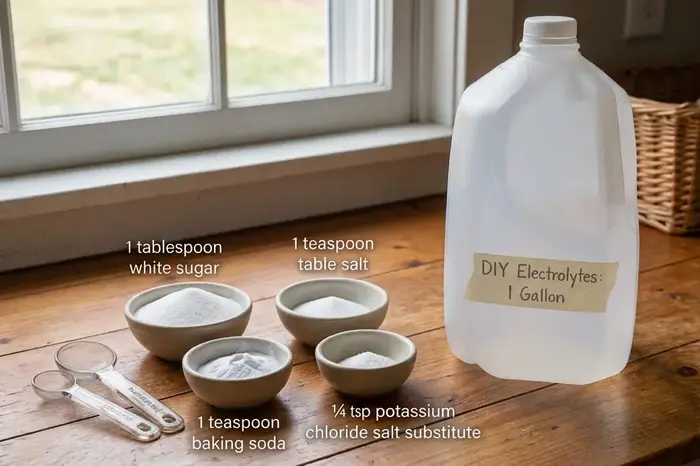
| Ingredient | Per 1 gallon (3.8 L) | What it does |
| Water, cool | 1 gallon (3.8 L) | The point of the exercise |
| Salt | 1 teaspoon (5 ml) | Sodium and chloride |
| Baking soda | 1 teaspoon (5 ml) | Buffers the alkalosis panting causes |
| Sugar | 1 tablespoon (15 ml) | Energy, and aids absorption |
| Potassium chloride, sold as “lite salt” or salt substitute | ¼ teaspoon (1.25 ml) | Replaces the mineral heat depletes most |
Stir until dissolved and use it cool. If you take nothing else from this article, add the potassium chloride line. It sells in any grocery store beside the regular salt, and it covers the deficit the standard recipe misses.
Molasses can stand in for the sugar and brings a little potassium and iron with it. It also loosens droppings, so use a scant tablespoon and skip it entirely for a bird already scouring.
Measure properly. This is the one place to be fussy — over-salting a waterer in hot weather makes dehydration worse, which is the opposite of the goal. Level spoons, not heaped.
What about “magic water”?
Magic water is a backyard staple. Mix 1 gallon (3.8 L) of water with 1 tablespoon (15 ml) honey, 1 tablespoon (15 ml) apple cider vinegar and a crushed garlic clove, then offer it to weak or newly hatched chicks.
I use it and I like it. But there’s no controlled research behind it, and it isn’t an electrolyte solution — it holds no meaningful sodium, potassium or chloride. The honey supplies quick energy, which is probably what you’re seeing when a flat chick perks up. For a genuinely depleted bird, use a real electrolyte mix. Treat magic water as a gentle pick-me-up, not a rehydration therapy.
Homemade or store-bought?
Both work. The honest split is that homemade wins on cost and store-bought wins on everything you’d rather not think about at 6 am during a heat wave.
| Homemade | Commercial packet | |
| Cost per gallon | A few cents | Roughly 30–75 cents |
| Dosing | You measure, every time | Pre-measured, no scale needed |
| Vitamins | None | A, D3, E, C and the B-group |
| Shelf life | Mix fresh every time | Sealed sachets keep for years |
| Best for | Adult birds in heat | Chicks, illness, anyone who’d rather not measure |
The vitamin content is the real gap. My homemade mix rebuilds minerals and nothing else, and for an adult hen in a heat wave that is all she needs — her daily water requirement is the number that matters, not her vitamin intake. A three-day-old chick out of a shipping box is a different case. She has spent her yolk reserves, and the vitamins in a commercial packet do work that salt and baking soda cannot.
So I keep both. Homemade for normal summer days, packets for the hottest days and when I’m short on time.
The three packets I actually buy
I read the ingredient panel on these, and the results reordered my own shelf. Ingredients are listed by weight, so whatever comes first is what you are mostly buying.
Sav-A-Chick — the one I reach for first
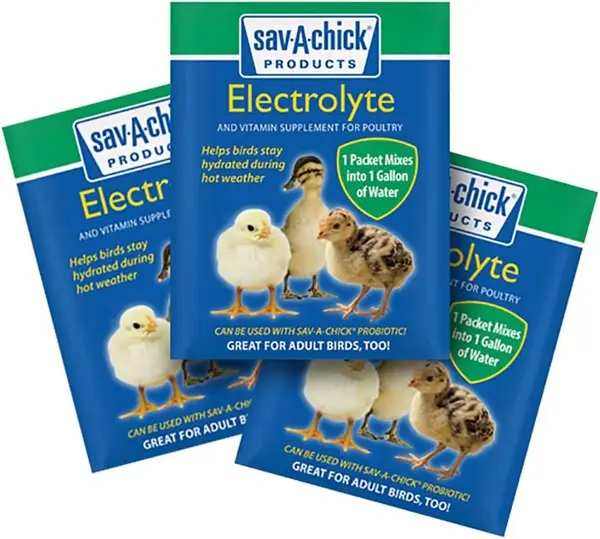
Sav-A-Chick Electrolyte and Vitamin Supplement leads with potassium chloride, then sodium citrate, sodium bicarbonate, and salt. That is close to the homemade recipe above, in the right order, with a full vitamin panel including vitamin C on top. Each foil sachet treats 1 gallon, so nothing degrades in a half-open tub.
The only thing I’d change is the Yellow 6 and Red 40. The dye is there so you can see the water is treated. Your hens do not care.
Rooster Booster — for chicks and after illness
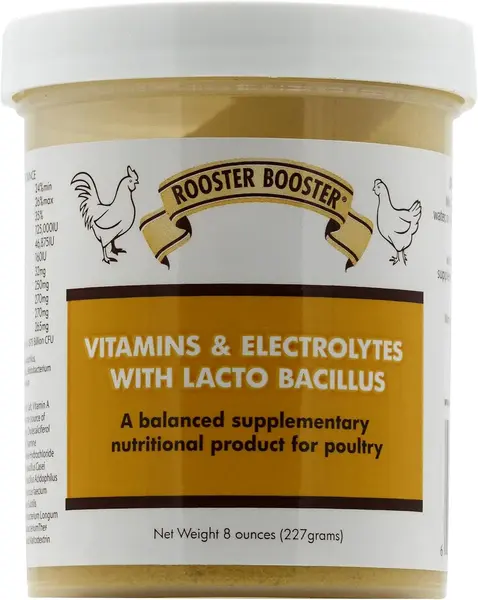
Rooster Booster Vitamins and Electrolytes with Lacto Bacillus also leads with potassium chloride, salt, vitamins, and adds six probiotic cultures — Bacillus subtilis, Enterococcus faecium, two Lactobacillus strains and two Bifidobacterium strains.
That combination is why it’s my pick for chicks and for birds coming off a course of antibiotics, where rebuilding gut flora matters as much as replacing minerals. It uses maltodextrin rather than added sugar, and no dyes. The 8 oz jar works out cheaper per gallon than sachets if you use it regularly.
Durvet — cheapest, and the label explains why
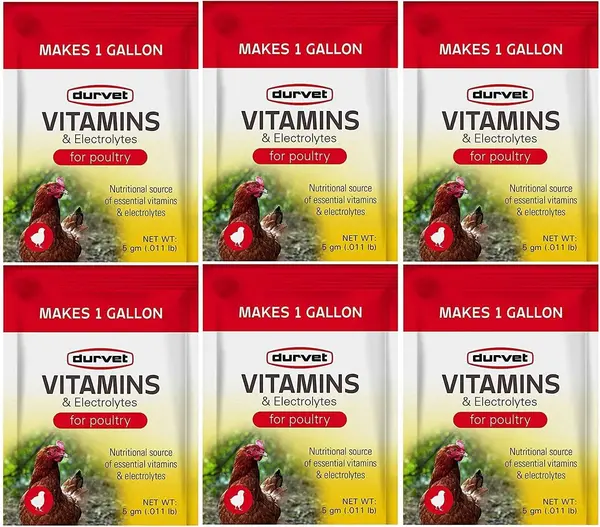
Durvet Vitamins and Electrolytes, six-pack of 5-gram packets, each making 1 gallon, is the budget option and it is genuinely cheap. The vitamin panel is comparable to the others.
But read the guaranteed analysis: salt 86–91%, sodium 32–39%, potassium a 2% minimum. Salt is the first ingredient and potassium sits third. It is, essentially, a salt-and-vitamin product.
That is not useless — sodium and chloride are lost in heat too, and the vitamins are real. It just doesn’t do the thing this article has spent 800 words arguing matters most. I keep a six-pack in the truck for shows and transport, where cheap and pre-measured beats optimal. For a heat wave at home I use one of the other two.
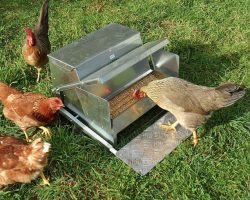
Whatever you mix it in matters as much as what you mix. A shallow, shaded drinker that’s easy to scrub gets changed daily; an awkward one doesn’t. Or pick a chicken waterer that is closed so it doesn’t get dirty. If you are dealing with freezing winter temperatures, my heated chicken waterer picks cover that end of the year. Conveniently, these work great in the summer, too—simply unplug them, and the built-in insulation will help keep the water cool. For details on how supplements fit into a complete poultry diet, check out the broader chicken feed and water guide.
How much to give, and for how long
Dosing is by concentration, not by bird. Mix the solution and let the flock drink free-choice — they self-regulate.
| Situation | Solution | Duration | Plain water alongside? |
| Forecast heat wave | Standard mix | Start 1 day before, through the hot spell | Yes — always offer both |
| Mail-order chicks | Commercial packet with vitamins | 3–5 days from arrival | No — sole source |
| Transported or shown adults | Either | 2–3 days | No — sole source |
| Recovery from diarrhea | Either | Until droppings firm up | No — sole source |
| Mild weather, healthy flock | None | — | Plain water only |
Commercial packets are usually sized for 1 gallon — check yours, because a few are sized for 2 and doubling by accident is easy.
Change it daily, without exception. Sugar plus warm weather plus an open drinker is a bacterial culture, and a fouled electrolyte waterer is worse than no electrolytes at all. In heat I swap mine morning and evening.
Never make it the only water in hot weather. Some birds dislike the taste, and a hen who refuses flavored water in a heat wave is in far more danger than one who never had electrolytes.
When chickens genuinely need electrolytes
Sustained heat, not just a warm afternoon
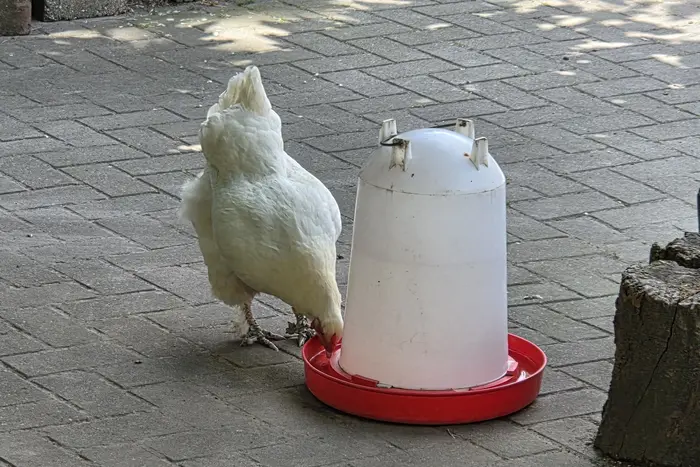
Heat stress begins around 80°F (27°C) and becomes obvious above 85°F (29°C). The trigger isn’t the peak temperature, it’s the duration — a single hot afternoon that cools off overnight doesn’t deplete a healthy hen. Three consecutive days above 90°F (32°C), or hot nights that never let the flock recover, do. Keep in mind that temperatures starting at 75°F (24°C) are already suboptimal for adult birds and can cause mild discomfort.
Timing is the part almost everyone gets backwards. Extension guidance is to start electrolytes before the heat arrives, not after birds are already panting hard. If a heat wave is forecast for Thursday, the mix goes in Wednesday morning.
Lightly flavored water also encourages birds to drink more of it, which is the whole point. Electrolytes are a hydration aid, not a cooling method. For the actual cooling work, see my guide on how to keep chickens cool in summer.
Newly arrived chicks and transported birds
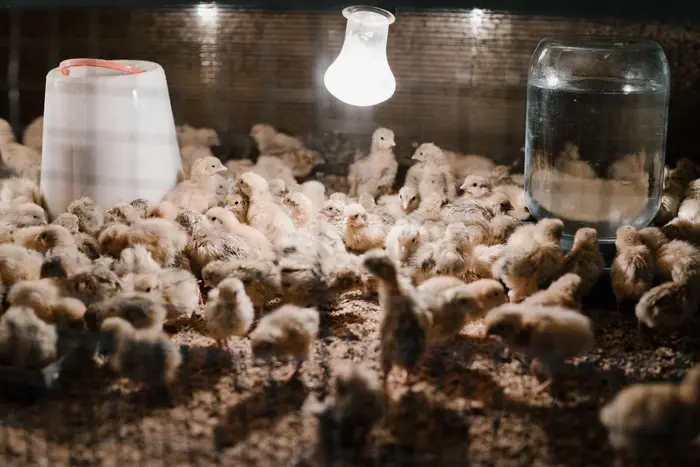
This is where electrolytes pull their weight hardest. A chick absorbs its yolk sac in roughly the first three days after hatch, which is exactly the window it spends in a shipping box. Chicks arrive with reserves spent and one objective: find water fast.
For shipping stress the protocol differs from the heat protocol in one important way. I advise offering the vitamin-electrolyte solution as the only drinking water until the stress has passed. Refresh it daily. Not alongside plain water — instead of it. Three to five days is plenty.
The same applies to any adult bird that has been crated, shown, rehomed or moved a long distance.
Illness, diarrhea and recovery
A bird losing fluid through watery droppings is losing minerals with it, and this is the classic case for a rehydration solution. Offer it as the only water source while the bird is actively scouring, then return to plain water once droppings firm up.
Two cautions. Electrolytes support a sick bird; they don’t treat the cause. And a bird too weak to drink on her own needs veterinary help, not a fuller waterer. Persistent diarrhea, blood in droppings, or a bird that won’t stand is a call to make, not a mix to stir.
When they don’t help
Healthy adult birds on complete feed, in mild weather, gain nothing. Mississippi State Extension is blunt about the chick version too: sugar and vitamin-electrolyte additives are not necessary for producing healthy chicks under normal, low-stress conditions.
Running them continuously has three real costs. Sugar in a waterer accelerates bacterial growth and algae, so the water gets dirtier faster. That is worth reading alongside how to keep chicken water clean and my guide to chicken water quality and access. Constant sodium loading is pointless when the feed already supplies it. And a flock that always has flavored water gives you nothing left to offer on the day it matters.
Four mistakes I see most often
Starting too late. By the time hens are panting with wings out, the depletion has already happened. Mix before the forecast heat, not during it.
Running them all season. It fouls water, wastes money and gives you nothing in reserve. Days, not months.
Making electrolyte water the only option in a heat wave. A hen who dislikes the taste will drink less, and less water in heat is the actual danger.
Buying on price without reading the panel. Two of the three products above lead with potassium chloride. One leads with salt. They are not interchangeable, and the label tells you in the first three words.
Frequently asked questions
What electrolytes can you give a chicken?
Sodium, potassium and chloride are the three that matter, plus a little sugar to aid absorption. A commercial poultry electrolyte packet supplies all of them. So does a homemade mix of salt, baking soda, sugar and a potassium-chloride salt substitute in 1 gallon (3.8 L) of water.
How to make magic water for chickens?
Mix 1 gallon (3.8 L) of water with 1 tablespoon (15 ml) honey, 1 tablespoon (15 ml) apple cider vinegar and one crushed garlic clove. Offer it to weak or newly hatched chicks. It’s an energy pick-me-up rather than a true electrolyte solution — use a proper mix for a depleted bird.
How to hydrate a sick chicken?
Offer an electrolyte solution as her only water source while she’s losing fluid, in a shallow dish she can reach without standing. If she won’t drink on her own within a few hours, she needs veterinary attention — a bird too weak to drink can’t be rehydrated by a fuller waterer.
What is the best homemade electrolyte solution?
Per 1 gallon (3.8 L) of water: 1 teaspoon salt, 1 teaspoon baking soda, 1 tablespoon sugar and ¼ teaspoon potassium chloride. The potassium is what separates it from the recipes you’ll usually find, and it targets the mineral heat depletes most.
Can I give electrolytes to chickens every day?
No — not as a routine. Use them for stress events lasting days: a heat wave, chick arrival, transport or illness recovery. Healthy birds on complete feed in mild weather gain nothing, and continuous use fouls water and wastes product.
Is homemade as good as store-bought?
For adult birds in heat, yes — the minerals are the same. For chicks and sick birds, no. Commercial packets carry vitamins A, D3, E, C and the B-group. A homemade mix has no way to supply those, and they are exactly what a depleted chick needs alongside the minerals.