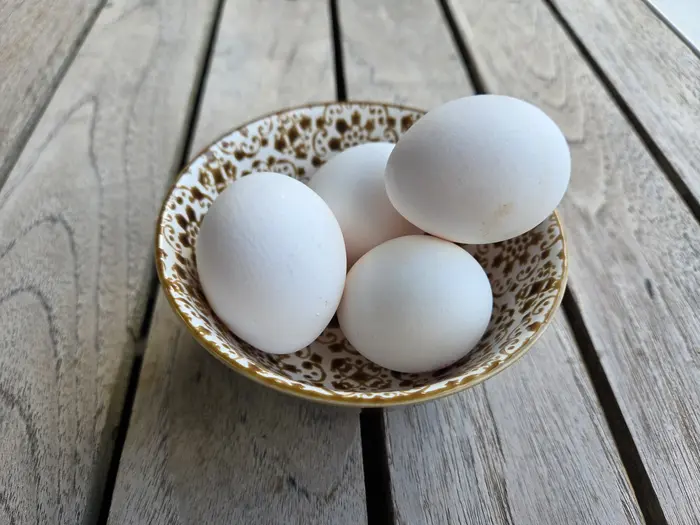
Fresh backyard eggs last 2–4 weeks on the counter or up to 3 months in the refrigerator — significantly longer than most people expect. The key is whether the natural protective coating on the egg, called the bloom, is still intact.
Quick answer: how long do fresh eggs last?
Unwashed backyard eggs: 2–4 weeks at room temperature, up to 3 months refrigerated. Washed eggs: 1–2 weeks on the counter, 5–8 weeks refrigerated. Hard-boiled eggs: up to 1 week in the fridge. The float test tells you if a specific egg is still good — see below.
I always get asked this at the gate when I sell surplus eggs. People reach for the carton expecting a printed date, find none, and look a little lost. The honest answer is that a backyard egg — unwashed, bloom intact — will outlast almost anything from the supermarket. Here’s exactly how long, why, and how to test any egg you’re not sure about.
How long do fresh eggs last — quick reference
Storage time depends on two factors: whether the egg has been washed, and whether it’s refrigerated.
| Storage method | How long |
| Unwashed, room temperature | 2–4 weeks |
| Washed, room temperature | 1–2 weeks |
| Unwashed, refrigerated | Up to 3 months |
| Washed or store-bought, refrigerated | 5–8 weeks |
| Hard-boiled (peeled or unpeeled), refrigerated | Up to 1 week |
| Frozen (beaten, in ice cube tray) | Up to 12 months |
Why the bloom makes such a big difference
When a hen lays an egg, she coats it in a thin, invisible protein layer called the bloom (also called the cuticle). This natural sealant covers the shell’s 7,000–17,000 tiny pores, keeping bacteria out and moisture in. It’s the reason a freshly laid egg doesn’t need refrigeration right away.
Commercial eggs in the US are washed in a warm chlorinated solution before packing to remove dirt and bacteria — a process that also removes the bloom. That’s why American store eggs must go straight into the fridge: without the bloom, the shell’s pores are open. In the UK and most of Europe, eggs are not washed commercially, so they sit unrefrigerated on supermarket shelves without issue.
Your backyard eggs, collected directly from the coop, still have their bloom — as long as you don’t wash them. Store them unwashed on the kitchen counter, away from direct sunlight and heat, and they’ll keep for two to four weeks. Wash only when you’re ready to use them.
Fridge or counter — which is better for backyard eggs?
Both work — the right choice depends on your kitchen and how quickly you go through eggs.
Counter storage keeps eggs at a stable room temperature (ideally below 68°F / 20°C). This is ideal if you collect daily and use eggs within two to three weeks. Keep them in a bowl or egg rack away from the stove and out of direct sun. In a hot kitchen in summer, move them to the fridge once temperatures regularly hit 77°F (25°C) or above.
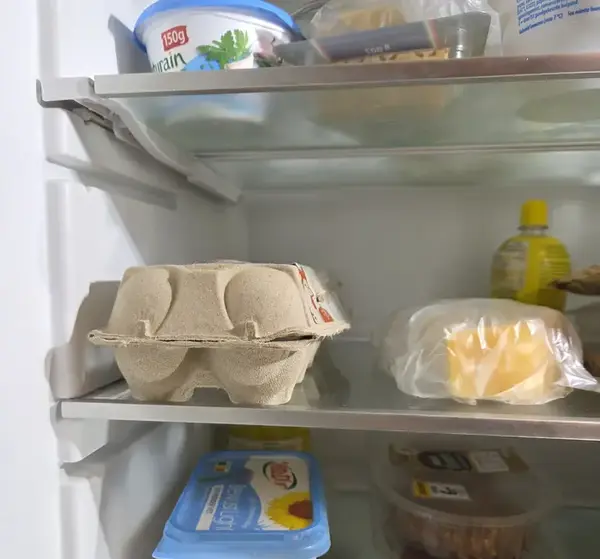
Refrigerator storage extends life considerably — unwashed eggs keep up to three months when refrigerated at a consistent 35–40°F (2–4°C). Store them in a carton (not the door, where temperatures fluctuate) with the pointed end down to keep the yolk centred.
One rule to follow: once an egg has been refrigerated, keep it refrigerated. Repeated temperature changes cause condensation on the shell, which can drive bacteria through the pores. If you’ve been storing eggs in the fridge and want to bring one to room temperature for baking, take out only what you need an hour before use.
How to tell if an egg is still fresh — the float test
The float test is the quickest freshness check available and works because of a simple fact: eggs lose moisture through their porous shell over time, and as water escapes, the internal air cell grows. A larger air cell = more buoyancy.
To run it, fill a deep glass or bowl with cold water and gently lower the egg in:
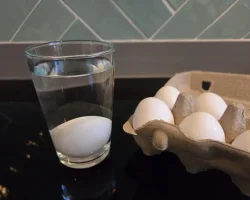
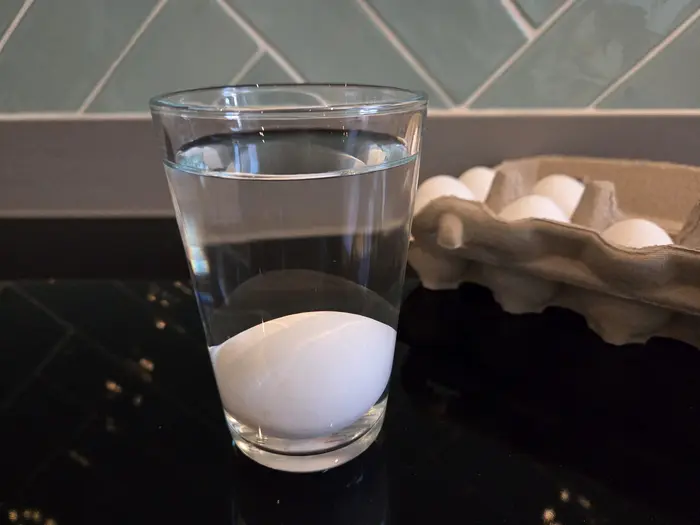
- Sinks and lies flat (see the image below) — very fresh. Cook however you like.
- Sinks but stands upright or tilts — getting older but still good. Fine for baking, omelettes, or hard-boiling.
- Floats — discard without cracking it open.
The float test tells you about age but not about contamination. Always do a smell test too: crack a suspicious egg into a separate bowl before using it. A fresh egg has virtually no smell; a bad egg has an unmistakable sulphur odour. If in doubt, throw it out.
Other signs an egg is past its best
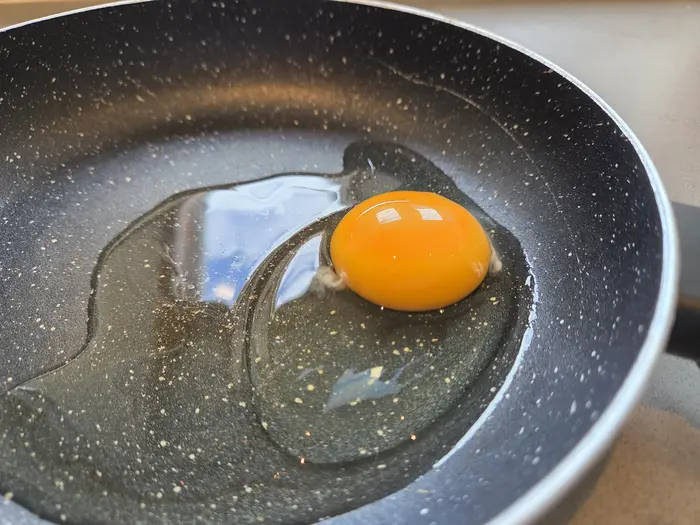
Even without the float test, cracking an egg onto a flat plate tells you a lot. A fresh egg has:
- A firm, domed yolk that holds its shape
- A thick, gel-like white that sits close around the yolk
- A smaller, thin watery white around the outside (normal in any egg)
An older egg spreads flat, the yolk is paler and breaks easily, and most of the white is thin and watery. Still edible if it passes the smell test — but better scrambled than fried, since the yolk won’t hold together well.
How long do hard-boiled eggs last?
Hard-boiling removes the bloom (via cooking) and the protective shell chemistry changes, so hard-boiled eggs need refrigeration and have a much shorter shelf life than raw ones.
Unpeeled: up to 1 week in the refrigerator. The shell still offers some protection.
Peeled: up to 5 days in the refrigerator, stored in a covered container or submerged in cold water (change the water daily).
One practical tip: use slightly older eggs for hard-boiling. Very fresh eggs are notoriously difficult to peel because the white clings to the membrane. Eggs that are 1–2 weeks old peel easily after boiling.
Can you freeze fresh eggs?
Yes — though not in the shell, which will crack as the liquid expands. To freeze eggs:
- Crack into a bowl, beat lightly to combine yolk and white, pour into ice cube trays.
- Once frozen, transfer to a labelled freezer bag.
- Add a pinch of salt or sugar per egg before freezing if using for savoury or sweet dishes — this prevents the yolk from becoming gelatinous.
- Use within 12 months.
Frozen eggs work best in cooked dishes — scrambled eggs, quiches, cakes, omelettes. Thaw overnight in the fridge before using. Don’t refreeze once thawed.
This is a useful option if your hens are laying heavily in spring and you want to build a reserve for the quiet winter months when production drops. For more on managing seasonal production, see why your chickens might not be laying.
Common myths about egg freshness
Myth: backyard eggs must be refrigerated immediately. Not if the bloom is intact. Unwashed backyard eggs are fine on the counter for two to four weeks.
Myth: a floating egg is always rotten. A floating egg is old enough that the air cell has grown large — it may or may not be rotten. It could simply be a few weeks old and still edible. Discard it regardless: the risk of food poisoning from Salmonella isn’t worth it.
Myth: the best-by date on a carton tells you when an egg goes bad. Best-by dates on commercial eggs are a quality indicator, not a safety cutoff. USDA guidance states that refrigerated eggs are generally safe to eat 3–5 weeks after purchase, past the stamped date, if properly stored.
Myth: brown eggs are fresher or more nutritious than white eggs. Shell colour reflects breed, not freshness or nutritional content. A white Leghorn egg laid this morning is no different in quality from a brown Rhode Island Red egg laid at the same time.
Frequently asked questions
Do you need to refrigerate backyard chicken eggs?
Not immediately, if they are unwashed and the bloom is intact. Store them at cool room temperature (below 68°F / 20°C) for up to two to four weeks. Once washed or once refrigerated, keep them cold.
How long can eggs sit out after being refrigerated?
A few hours at room temperature is fine — for example, bringing them to room temperature before baking. Do not leave refrigerated eggs out for more than two hours in a warm kitchen. If condensation forms on the shell, bacteria can enter through the pores.
Can you eat eggs past the best-by date?
Often yes, if stored correctly and they pass the float test and smell test. The USDA advises that refrigerated eggs remain safe for 3–5 weeks after purchase. Backyard eggs without a printed date should be used within the windows above.
How do you know if a fresh egg has gone bad?
Use the float test (a floating egg should be discarded), then crack it into a separate bowl and smell it. A bad egg has a strong sulphur smell that is impossible to miss. If it floats or smells off, discard it.
Why do backyard eggs last longer than store eggs?
Store eggs in the US are commercially washed, which removes the natural bloom and opens the shell’s pores to bacteria. They must be refrigerated immediately. Backyard eggs collected with care retain their bloom, sealing the shell and extending shelf life at room temperature.
How long do fertilised eggs last compared to unfertilised?
The same length of time, assuming both are collected promptly and stored identically. A fertilised egg at room temperature will only begin developing if it is incubated (held at around 99°F / 37°C for extended periods). Normal kitchen temperatures do not trigger development.
Sources: USDA Food Safety and Inspection Service — Shell Eggs from Farm to Table; FDA — Egg Quality and Safety; Penn State Extension.