Few things match the excitement of waiting for your backyard flock’s first egg. But when do hens start laying eggs? While most pullets begin between 18 and 22 weeks of age, the exact timing depends on the breed. I still remember the morning I found my first tiny, lopsided egg from a hen named Pip—I’d all but given up checking, and there it was, warm in the corner of the nesting box. After a decade as a poultry specialist, that jolt of excitement hasn’t worn off. Here is exactly when to expect that first egg, how to read the signs, and how to help your hens get there.
Average Age Chickens Start Laying
A young hen is called a pullet until she’s about a year old, and the point when she lays her first egg is called “point of lay.” For most backyard breeds that lands at 18–22 weeks (roughly 4.5–5 months).
Three things shift that window:
- Breed type — lighter, production-focused breeds mature faster than large heritage breeds.
- Daylight — laying is triggered by light. Pullets that reach maturity as days are lengthening (spring/early summer) often start right on schedule; those maturing into shortening autumn days may wait until spring.
- Health and nutrition — well-fed, low-stress birds reach point of lay sooner.
First-Egg Age by Breed
Use this as a guide — individuals vary by a week or two either way.
| Breed | Typical first-egg age |
|---|---|
| Leghorn | 16–18 weeks |
| ISA Brown / Golden Comet | 16–20 weeks |
| Rhode Island Red | 18–20 weeks |
| Plymouth Rock | 18–20 weeks |
| Australorp | 20–22 weeks |
| Sussex | 20–24 weeks |
| Wyandotte | 20–24 weeks |
| Bantams (most) | 20–24 weeks |
| Marans | 24–28 weeks |
| Buff Orpington | 24–28 weeks |
| Brahma | 28–32 weeks |
| Silkie | 28–36 weeks (7–9 months) |
If you want eggs sooner rather than later, choose from the best egg-laying breeds for beginners. Most of these breeds are early, reliable starters.
5 Signs Your Hen Is About to Lay
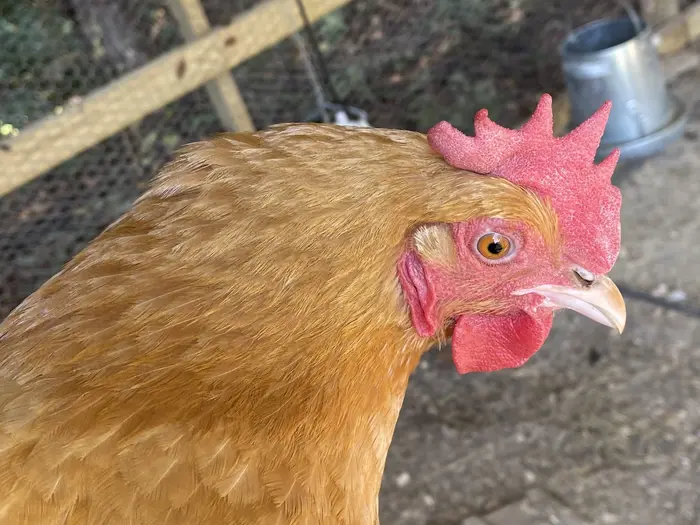
You’ll usually get a week or two of warning. Watch for:
- A red, full comb and wattles. As a pullet matures, her pale comb and wattles deepen to a bright, vibrant red — the clearest visual signal.
- The “squat.” When you reach toward her, she crouches low with wings slightly out. This submissive squat means she’s hormonally ready to lay.
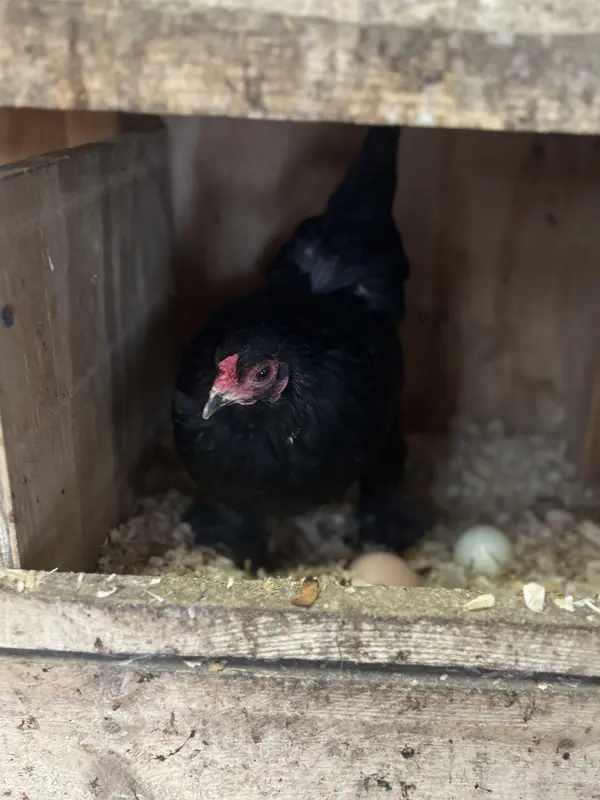
- Nesting-box investigation. She’ll start poking around the boxes, scratching and rearranging bedding, and “trying them out.”
- Louder, chattier behavior. Many pullets get vocal, including the first attempts at the “egg song.”
- A widening pelvic gap. Gently feel the two pelvic bones near the vent: about two finger-widths apart means laying is imminent (one finger-width = not yet).
What Does a Hen’s First Egg Look Like?
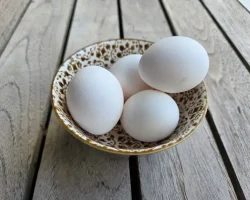
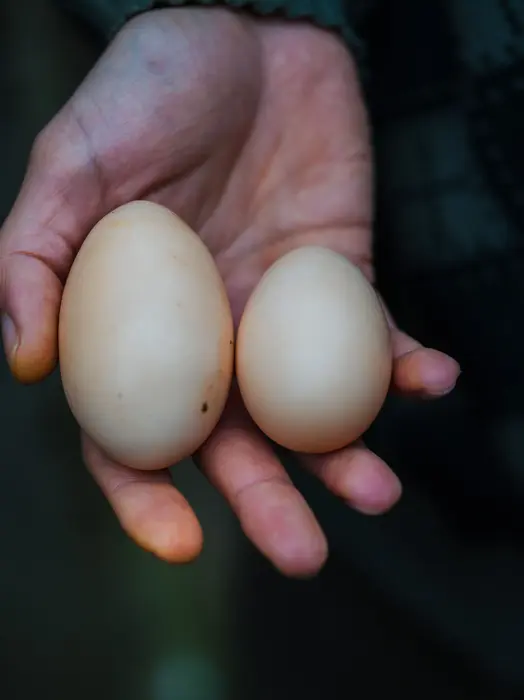
Don’t be surprised if the first egg is a bit of an oddball. First eggs are often small (“pullet eggs”), sometimes soft-shelled or shell-less, and occasionally an odd shape or double yolk egg (see image below on the left). Double-yolk eggs are very large, almost double the size of a normal egg, and when you open them they contain two yolks. This is completely normal as her reproductive system calibrates. Within a couple of weeks the eggs settle into a consistent size, shape and shell quality.
What to Do When the First Egg Arrives
That first egg is a milestone — here’s how to handle the early days well:
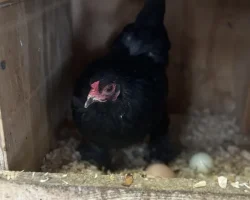
- Leave a nest egg in place. A ceramic egg or golf ball in the box reassures a nervous new layer that this is the spot, and discourages floor-laying and hidden nests around the yard.
- Collect often. Early eggs can be fragile and are tempting targets for curious flock-mates; gather them at least once a day (more in summer heat) before anyone develops an egg-eating habit, which is hard to break.
- Don’t wash them right away. A fresh egg has a natural protective “bloom.” Store unwashed eggs at cool room temperature and only wash just before use, or refrigerate if you prefer — but skip the scrubbing until you’re ready to cook. (For safe egg handling and reducing Salmonella risk from backyard flocks, see the CDC’s backyard poultry guidance.)
- Expect a wobble. Soft shells, double-yolkers, tiny “fairy eggs” and the odd miss are all normal for the first few weeks while her system finds its rhythm. Keep oyster shell grit or limestone grit available and give it time.
Jot the date of that first egg in your free Chicken Log egg tracker — it’s the starting line for tracking each hen’s productivity, and it’s lovely to look back on.
Why Are My Chickens not Laying Eggs Yet?
If your pullets are past the expected age and still no eggs, the usual culprits are:
- They’re simply not old enough for their breed (check the table above).
- Too little daylight — hens need ~14–16 hours of light to lay consistently; as Penn State Extension notes, day length is the primary trigger for egg production.
- Stress — a recent move, new flock members, predators, disease, or extreme heat can delay things.
- No or inadequate nesting boxes — hens will preferably lay eggs in a nesting box that is in a darker space and provides protection. Without a nesting box, your hens will lay eggs, but you probably haven’t found them yet. Floor eggs could be hidden under bushes in your outdoor chicken run. If you’re not up for an easter hunt every day, check out our guide to the best nesting boxes.
- Diet — pullets need to be on a layer feed (~16% protein + calcium) once they approach point of lay.
- Breed expectations — a Silkie or Brahma is just slower than a Leghorn.
Common Myths About When Hens Start Laying
A few persistent myths trip up new keepers every spring, so let me clear them up:
- “My hen needs a rooster to start laying.” She doesn’t. Hens lay on their own hormonal schedule; a rooster only makes the eggs fertile, not more frequent.
- “All my pullets will start on the same day.” They won’t, even from the same hatch. Individuals vary by a week or two, and different breeds in a mixed flock can be a month or more apart — so don’t worry if one hen lays well before her hatch-mates.
- “Bigger or older-looking birds lay first.” Not necessarily. A lean Leghorn will usually beat a heavy, slow-maturing Brahma to the nest box by months, despite looking less “grown up.” Maturity for laying is about breed and light, not bulk.
- “Once she starts, she’ll lay every day forever.” Early laying is often irregular for the first few weeks while her system calibrates, and even a strong layer takes natural breaks for molting and short winter days.
How to Encourage Those First Eggs
You can’t rush biology, but you can remove the brakes:
- Switch to layer feed at about 18 weeks (or when the first egg appears) and offer chicken grit that contains calcium (oyster shell or limestone grit) free-choice for strong shells.
- Maximize light. As days are long in June this is rarely an issue now, but heading into autumn a timed coop light topping daylight up to ~14–16 hours keeps laying going. See chicken lighting and egg production.
- Keep stress low. Calm, predictable routines, no overcrowding, and protection from predators all help.
- Have boxes ready. One clean, private, slightly dim nesting box per 3–4 hens, with a fake “nest egg” to show them where to go.
How Many Eggs to Expect in Year 1
Once they get going, your first year is the most productive. Strong layers (Leghorns, ISA Browns, Australorps, Rhode Island Reds) often produce 250–300+ eggs in their first full laying year. Heritage and ornamental breeds lay less but offer other qualities. Expect a natural pause during their first autumn molt, and a slowdown over the short days of winter unless you add light.
When Do Chickens Stop Laying?
Hens don’t suddenly stop — they gradually slow down. Most lay best in years 1–2, then taper by roughly 10–20% a year. Many backyard hens keep laying (fewer, larger eggs) for 5–7 years or more, especially heritage breeds.
Only in certain cases do hens temporarily stop laying; in winter with short daylight and no or little artificial lighting, when they’re molting, stressed or sick, or when nutrition is poor.
Frequently Asked Questions
Do chickens lay eggs without a rooster?
Yes. Hens lay eggs whether or not a rooster is present — you only need a rooster if you want fertilized eggs to hatch.
What month do chickens start laying?
It depends on when they hatched, not the calendar. A pullet reaches point of lay at ~18–22 weeks; spring chicks typically start in late summer to early autumn. Birds maturing into short winter days may hold off until spring.
Why is my pullet laying soft-shelled eggs?
Soft or shell-less first eggs are normal as her system starts up. If it continues, she likely needs more calcium — offer crushed oyster shell or limestone grit free-choice alongside her layer feed.
Can chickens lay year-round?
They can, but most slow or stop over winter due to short days and molting. Providing supplemental light to reach ~14–16 hours can keep production steady through winter.
How do I know if my hen will ever lay?
Check her age against her breed, look for a red comb and the squat, and feel for a two-finger pelvic gap. If she’s mature, healthy, well-fed and getting enough light, normally she should be laying.
Should I switch to layer feed before or after the first egg?
Switch to a layer feed (≈16% protein plus calcium) at around 18 weeks, or as soon as you see the first egg — whichever comes first. Switching too early loads young birds with more calcium than growing bodies need, so don’t rush it for a heavy breed that matures late. Always offer crushed oyster shell free-choice alongside, so each hen can top up calcium as her own laying demands.
Where should I put the nesting boxes so she’ll use them?
Set boxes in the darkest, most private corner of the coop, lower than the roost bars (or hens will sleep and poop in them), with one box per three to four hens. A clean handful of straw and a fake “nest egg” or golf ball shows a first-time layer where the family business happens. Get this right before point of lay and you’ll avoid the classic beginner problem of eggs laid on the floor or hidden around the yard.