When you keep backyard chickens, you don’t have a printed expiration date to rely on. Instead, you learn to judge an egg by how it looks, smells, and behaves. So, how to tell if an egg is still fresh? And how to tell if an egg is bad?
How to tell if an egg is fresh:
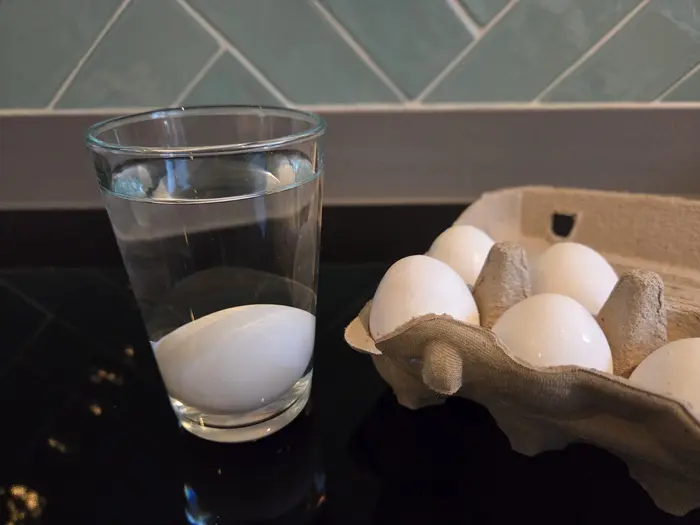
A fresh egg sinks and lies flat in a bowl of cold water (float test), has a firm, rounded yolk, a thick egg white (crack test), and no smell when cracked open (smell test).
An old egg usually floats and has a flat yolk and watery white.
A bad egg gives off a strong sulphur or rotten odor. If an egg smells bad after cracking, discard it immediately, regardless of the results of the other tests.
Over the years, I’ve found that no single test tells the whole story. I usually start with the float test because it only takes a few seconds, then confirm the result by cracking the egg and checking its appearance and smell if I’m still unsure. But five simple tests in total will help you tell whether an egg is fresh, simply older, or bad and no longer safe to eat.
What you need to test an egg
Most freshness tests require only a few simple items:
- A deep glass or bowl of cold water (for the float test)
- A clean plate or frying pan (for the crack test)
- A bright torch or phone light (for the optional candle test)
Test 1: The float test (fastest)
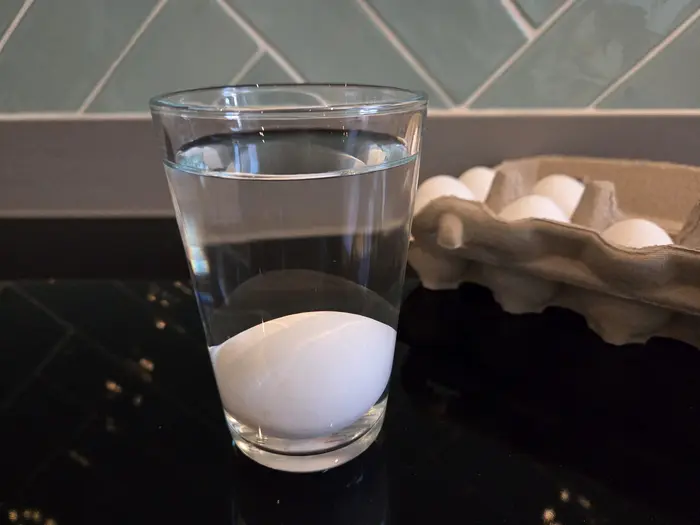
This is the classic and quickest test. It works because eggs lose moisture through their porous shell over time, and the internal air cell grows as they age — so older eggs are more buoyant.
Fill a deep glass with cold water and gently lower the egg in:
- Sinks and lies flat on its side — very fresh.
- Sinks but stands upright on one end — older, but still good. Use soon; great for hard-boiling.
- Floats to the surface — egg is old and should be discarded. The air cell is large enough to signal that it is past its best.
The float test measures age, not contamination. A floating egg should be thrown out, but an egg that sinks can still occasionally be off — so pair the float test with the smell test.
Test 2: The crack test (best visual check)
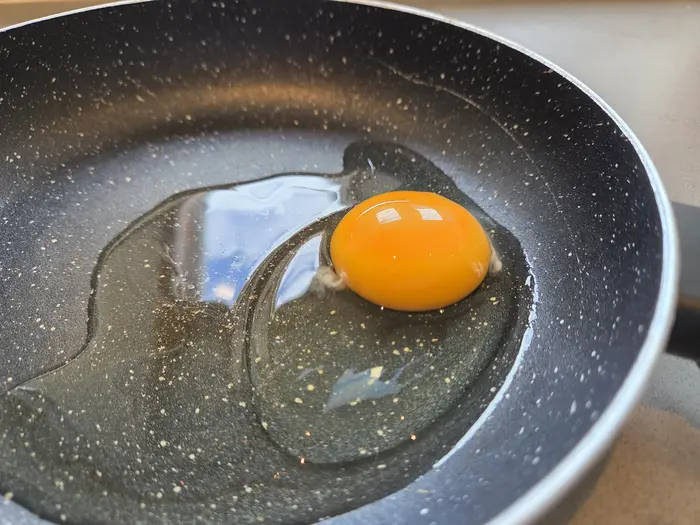
Crack the egg onto a flat plate or frying pan (not into a bowl) and look at how it sits. This is the most reliable visual test.
A fresh egg usually has:
- A tall, rounded yolk that holds its shape
- A thick egg white that stays close around the yolk
- A firm appearance when cracked open
An older egg usually has:
- A flatter yolk that spreads easily
- A thinner, watery egg white
- Less structure when placed on a plate
An older egg is not automatically bad. If it smells normal, it is often still fine for scrambled eggs, baking, or other cooked dishes. I personally prefer using older eggs for hard-boiling because they are much easier to peel than very fresh eggs.
Test 3: The smell test (the decider)
This is the ultimate check. Crack the egg into a separate bowl and smell it. A fresh egg has virtually no smell. A bad egg has an unmistakable, powerful sulphur (rotten) odour that you will recognise instantly. If it smells off, discard it — no matter what the other tests said. Cracking into a separate bowl first means one bad egg never ruins a whole recipe.
Test 4: The shake test
Hold the egg to your ear and shake it gently. A very fresh egg makes no sound because the contents fill the shell firmly. If you hear or feel a sloshing or sliding, the contents have shrunk and thinned with age — the egg is older and best used soon or discarded if it also fails other tests.
Test 5: The candle test (most precise)
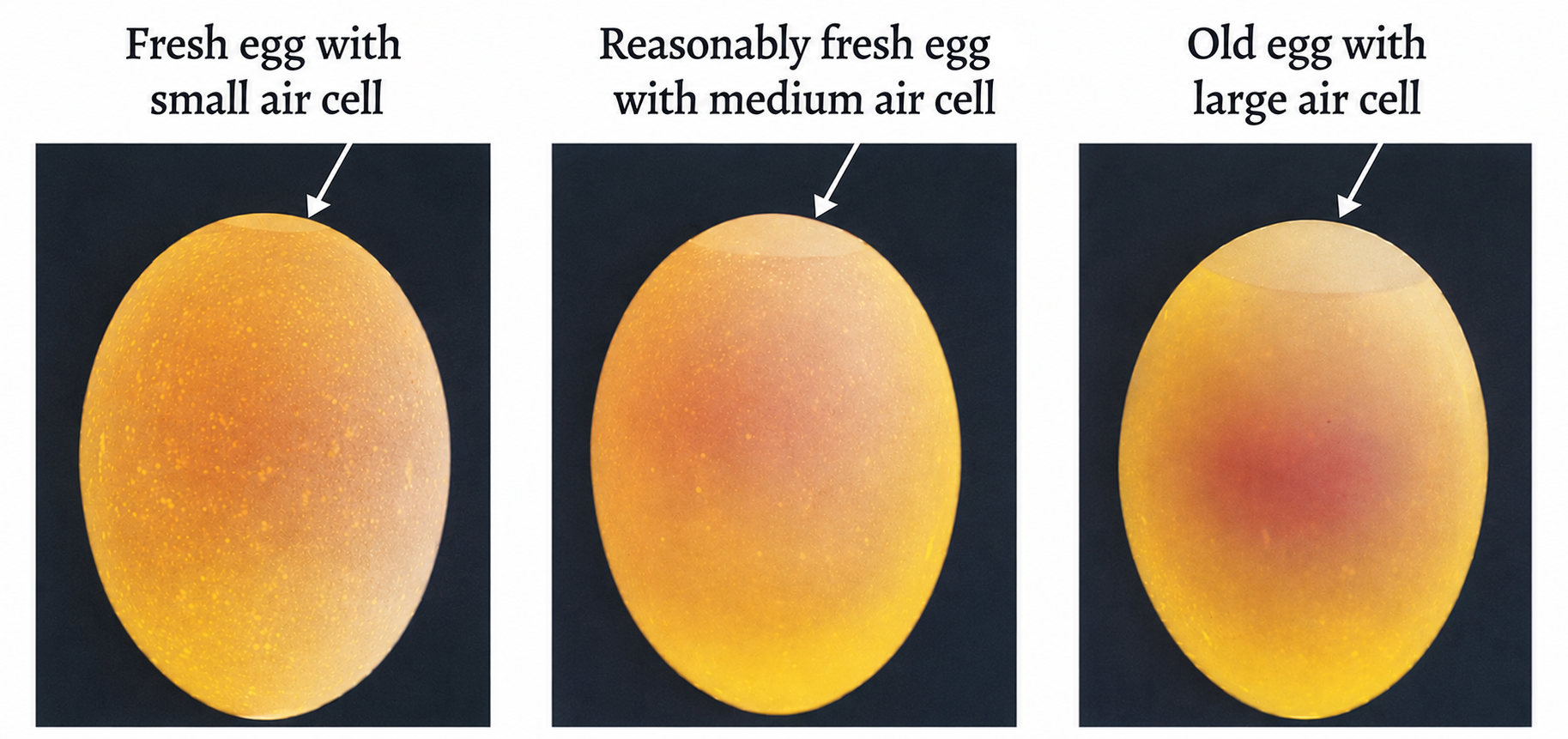
Candling is a technique used by commercial egg graders and poultry keepers to inspect eggs from the inside. The University of Illinois Extension explains how candling can be used to check egg quality and the size of the internal air cell (University of Missouri Extension — Egg Quality and Candling).
To candle an egg:
- Darken the room.
- Hold a bright flashlight against the wide end of the egg.
- Look at the size of the air cell inside.
Generally:
- A small air cell (less than 1/8 inch deep) means a very fresh egg.
- A large air cell means an older egg.
Candling is the method commercial graders use and is especially handy for checking a whole batch quickly. It also reveals cracks and internal defects. Candling is also used to check the incubation progress of fertilized eggs, to see if the chick embryo is growing well.
How to Know If an Egg Is Bad
An older egg is not necessarily spoiled. However, you should discard an egg if you notice any of these signs:
- Strong rotten or sulphur smell
- Mold or unusual discoloration
- Slimy or unusual texture
- Cracked shell with leakage
- Strange appearance after cracking
When in doubt, throw it out. A single egg is not worth risking food safety.
Why Eggs Become Less Fresh
Eggs age as moisture and carbon dioxide escape through the shell’s pores, shrinking the contents and enlarging the air cell. Storage slows this dramatically: an unwashed egg with its bloom intact ages far more slowly than a washed one. Therefore, you definitely shouldn’t wash fresh eggs.
Wondering how long eggs stay fresh? Read our guide on how long fresh eggs last for expected storage times under different conditions. Also, learn how to store fresh eggs to keep them fresher for longer.
Frequently asked questions
Is the float test always accurate?
It is accurate for measuring age but not contamination. A floating egg is old and should be discarded. An egg that sinks is usually good, but always confirm with a smell test after cracking, since a sunken egg can rarely still be off.
Can you eat an egg that stands upright in the float test?
Yes. An egg that sinks but stands on one end is older but still safe and good to eat. Use it soon — it is ideal for hard-boiling because slightly older eggs peel more easily.
How long do fresh eggs stay good?
Unwashed eggs keep 2–4 weeks on the counter and up to 3 months refrigerated. Washed eggs keep 1–2 weeks on the counter and 5–8 weeks refrigerated. Always test if you are unsure of an egg’s age.
Why does a bad egg float?
As an egg ages, moisture evaporates through the shell and is replaced by air, enlarging the internal air cell. Enough air makes the egg buoyant, so it floats — a reliable sign it is too old to use.
What does a rotten egg smell like?
Unmistakably of sulphur — a strong, foul, rotten smell. A fresh egg has almost no odour. If you get even a hint of that sulphur smell when you crack an egg, discard it immediately.