
Working out what to feed chickens in winter is the part of cold weather keeping that people overthink the most. Every autumn the same advice circulates: switch to a winter ration, load them with corn, hang the suet blocks. Almost none of it holds up. What actually changes when the temperature drops is far simpler, and it costs you nothing to get right.
The short answer: There is no special winter feed. Keep the same layer or all-flock feed and let them eat all they want. Add scratch grains such as corn in a second feeder so they can choose: maximum 10 percent when they lay eggs, to up to about 30 percent of the diet once they stop laying. Keep grit, oyster shell and unfrozen water available.
Below is what that looks like in practice, and why the water, not the feed, deserves most of your attention.
Chickens do not need a special winter feed
There is no winter formulation. A complete layer feed is already balanced for a hen’s requirements, and those requirements do not change shape because it is January. What changes is the energy she burns holding her body at 105°F (41°C) in air that is 20°F (-7°C).
She solves that herself, by eating more. A chicken eats to meet its nutrient and energy need, which is why the feeder empties faster in a cold snap without you touching the recipe. Stir grain into that recipe and you break the balance, because every scoop dilutes the protein, vitamins and minerals in the rest of it.
So the ration stays put. Offering grain beside it in a second feeder is a different thing, and I come to that below. Still deciding what the ration should be? My guide to choosing the best chicken feed covers the forms and protein levels, and the chicken feed and water hub collects the rest.
How much more feed a hen eats in the cold
The 25 percent figure, and where it comes from
University of Minnesota Extension puts the increase at up to 25 percent during cold weather. Ohio State University Extension gives a baseline of roughly 2 pounds (0.9 kg) per laying hen per week. At the peak of a freeze, that works out at about 2.5 pounds (1.1 kg).
For six hens over a three month winter, the difference is somewhere near 40 pounds (18 kg) of feed. Worth budgeting for, not worth panicking about. In practice: keep the feeder full and stop rationing. A hen cannot overeat a balanced layer feed the way she can overeat treats.
Whether your feed bill rises or falls depends on laying
Here is the part nobody reconciles. Ohio State says chickens eat less in winter than in summer. Minnesota says intake rises by up to a quarter. Both are correct, and the difference is whether your hens are still laying.
An egg costs a hen real energy. When daylight drops below about 14 hours, laying stops or slows and that cost leaves her budget. The saving can outrun the extra she burns on heat.
A flock in full lay through a cold December eats noticeably more. A flock that has downed tools eats less. If yours has stopped, why chickens stop laying eggs walks through whether that is daylight or something else.
Should you feed corn or scratch grains in winter?
Yes. Not as a treat, and not because corn is warming, but because it hands the bird a lever she cannot otherwise reach.
Most advice treats scratch as a guilty pleasure to be rationed. That is right for a flock in full lay, and wrong for the flock most people have in January.
A bag of feed is one fixed recipe, and she is not
Layer feed arrives at a set ratio: roughly 16 percent protein and around 2,800 kcal per kilogram, blended for a hen laying five or six eggs a week. Winter changes what she needs. It cannot change what is in the bag.
She needs more energy to stay warm. If she has stopped laying, she needs less protein and far less calcium than that bag assumes. So covering the cold with a quarter more feed also hands her a quarter more protein she cannot use, which she then has to strip the nitrogen off and excrete. That costs her energy and puts extra moisture and ammonia into a closed coop.
Corn on the side gives her a choice
One feeder is an instruction. Two feeders are a choice, and the second one does something no bag can do.
Corn is close to the mirror image of layer feed: about 7.5 percent protein at 3,373 kcal per kilogram, according to university poultry extension. Less than half the protein, around 20 percent more energy, close to pure fuel.
Put both in front of her and she balances how much she eats of each, topping up calories from the grain and taking protein and calcium from the feed. Hens read their own energy needs well, which is why oyster shell works offered free choice.
So you no longer have to get it right. You are not calculating a winter ration, you are handing her the two halves of one and letting her do the sum, and she adjusts faster than you would ever change a feed.
You can watch it happen. Deep in a freeze the grain feeder empties faster. When they come back into lay in spring, they walk past it for the feed.
One condition, and it carries most of the benefit: keep the two in separate feeders. Mixed together she can still sort, and she will, but every mouthful now sits nearer the ratio you chose than the one she wanted. The more grain you stir in, the less room she has to correct it, until she cannot pick the feed out at all. That is the real content of the usual warning about diluting a ration.
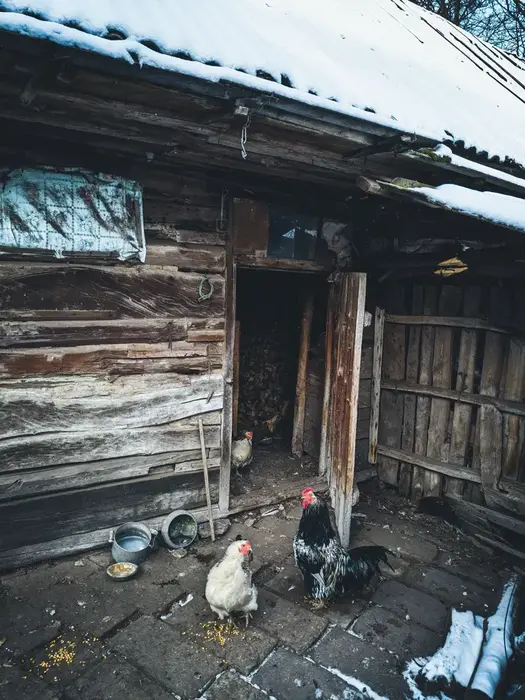
Also, you can scatter part of the grains on the ground, to give your hens something to scratch at and exhibit their natural behavior.
How much grain, and when to pull it back
While they are laying, hold to the usual limit. Oregon State Extension puts scratch at 10 to 15 percent of daily intake, or as much as they clear in about 20 minutes. A laying hen who fills up on grain gives you thin shells by February.
Once the eggs stop, that changes. Manitoba Agriculture reports hens choice-fed from separate feeders can take 70 percent of their diet as whole grain. Mixed into the feed the ceiling drops to 50 percent, because past that they cannot find the supplement among the grain.
I would not aim for 70 with ordinary layer feed. That figure assumes a balancer concentrate in the other feeder, and your layer feed carries the vitamin and mineral premix dosed for a full ration.
About 30 percent is my working number, and the arithmetic is kind. Winter intake is already up a quarter, so at 30 percent grain she still eats roughly 87 percent of a full summer ration. The premix barely moves, and it is still triple the summer allowance. When they come back into lay, back to 10 percent.
Put it out late in the day
Ohio State recommends grain late in the day, so the crop is full going into the night and she has something to work on in the coldest hours. Morning scratch does the opposite: it blunts her appetite for the feed she still needs.
Watch condition rather than the scoop. A hen eating almost nothing but grain, or losing cover over her breastbone, is telling you to shift the balance back.
Treats, scraps and greens: where they fit
Winter is when treat discipline slips, because the birds look cold and pathetic and the kitchen produces scraps. The 10 percent rule above covers all of it: scratch, scraps, greens, everything that is not complete feed, under about a tenth of what they eat in a day.
Winter grain is the one thing that steps out of that budget, and only while they are off lay. Scraps and treats never do, however busy the grain feeder gets.
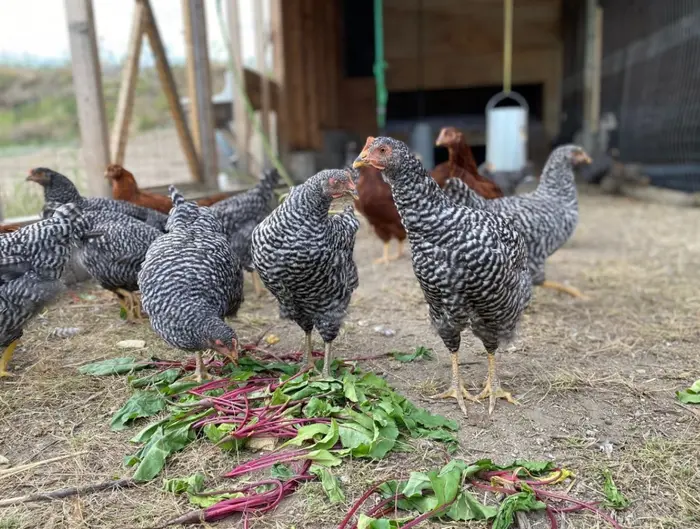
Within that budget, greens are the ones worth giving. A cabbage on a string, some kale, a handful of leftover salad. They cost almost nothing nutritionally, but they stop the boredom pecking that runs riot in a shut-in flock, and pecking each other is the classic January problem in a small coop. My chicken treats guide has the full list and the amounts.
Three things to skip. Warm mash every morning, which cools within minutes and teaches the birds to wait for it. Anything moldy from the back of the fridge, because cold weather does not make spoiled food safe. And suet or fat blocks meant for wild birds, which are formulated for a completely different metabolism.
Nobody needs extra protein in winter, molting birds included
Ohio State puts a laying hen’s winter requirement at 14 to 17 percent crude protein. Any standard layer feed already meets that. There is no cold weather protein deficit to correct, and the high protein sacks sold for winter solve a problem your flock does not have.
Why a molting hen needs less protein, not more
The molt looks like the obvious exception. It is not, and the arithmetic runs the other way.
Feathers are roughly 85 percent protein, and a complete new set for an average hen is something like 75 grams of it. Spread that over the two months a molt takes and it comes to a little over 1 gram a day.
Now count what she has stopped doing. Every egg carries about 6 grams of protein, so a hen laying five a week is putting out more than 4 grams a day. Stopping laying frees up three or four times more protein than her feathers are asking for.
So her total requirement falls during a molt. It does not rise. That is why a normal ration is enough, and why the 20 percent molt bags are theater. I go into it properly in my article on chicken molting.
Grit and oyster shell are year round, not a winter fix
Plenty of winter articles list these as things to add in the cold. They are not. Both belong in their own dishes, free choice, twelve months a year. If they are already there, winter changes nothing.
What winter changes is who gets caught out. A free ranging hen picks up her own grit all summer. Small stones from a path, coarse sand from a dust bath. Under snow or frozen ground all of that vanishes overnight, and a chicken with no grit cannot grind what she eats. If you have been getting away with not offering any, this is the season it shows.
Chicken grit is cheap and a bag lasts a backyard flock a very long time. My full explanation of the two types and what each one does is in my guide to chicken grit.
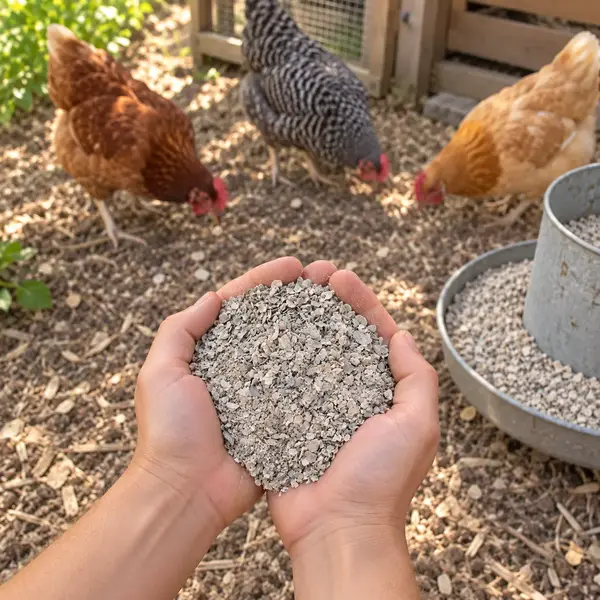
Oyster shell sits in its own dish beside it, also free choice, for any hen still laying. Never mix either one into the feed. Birds regulate their own intake accurately when it is offered separately. Mixing it in overdoses the birds that do not need it.
Water decides whether they eat at all
Feed is the topic, but water is the constraint. Minnesota Extension puts it plainly: without water, chickens stop eating. A frozen drinker on a 10°F (-12°C) morning does more than dehydrate your flock. It shuts down the feed intake you have just worked out how to increase.
Ohio State’s low tech version is to change the water twice a day, more often when it is colder. That works if you are home. If you are not, a heated drinker removes the problem entirely. I have compared the ones worth owning in the best heated chicken waterers. For the cheaper routes, from black rubber tubs to ping pong balls, see how to keep chicken water from freezing.
Check it morning and evening whatever system you use. A drinker that froze at 2pm is a whole afternoon your birds did not eat.

The temperature to aim for is 50 to 60°F
Not freezing is the floor, not the goal. University of Kentucky poultry extension puts the optimum for mature birds at 50 to 60°F (10 to 15°C).
Below about 41°F (5°C), birds simply drink less, and less water means less feed. There is a small thermal cost too. A hen drinks roughly a cup (240 ml) a day, and warming that from near freezing to her body temperature costs her about 10 kcal, near enough 3 percent of her daily energy. Bring the water to 55°F (13°C) and that drops by about a third. Small, but it is free.
Do not overshoot the other way. Warm water is a bacterial incubator, and commercial houses flush their lines once water passes 86°F (30°C) for exactly that reason. Birds drink less as it warms, too.
If your heated drinker has an adjustable thermostat, 50°F is the setting. If it is a fixed unit holding 35 to 45°F, that is fine and far better than ice.
What I learned about this the hard way
In a commercial layer house the ration barely moves between January and July, because the house does not. Ventilation, insulation and stocking density hold the air near 65°F (18°C) all year. Intake is metered against a bird that never really feels winter.
My first winter with a backyard flock, in an ordinary uninsulated coop, I went hunting for that winter formulation out of habit. There wasn’t one. What there was, once I bothered to weigh it, was a feeder emptying about a fifth faster than in September. The birds had already made the adjustment.
All I had to do was keep the feeder full and the water liquid. Everything I have read since agrees with what that feeder was telling me.
Not sorted the coop side of winter yet? My winter chicken coop tips and the guide to preventing frostbite in cold weather cover that ground.
Frequently asked questions
How cold is too cold for chickens?
Most standard breeds handle temperatures down to around 0°F (-18°C) without trouble. They need to be dry, out of the wind and on a draft free roost. Wet and windy is far more dangerous than simply cold. Combs and wattles are the first things to suffer, well before the bird itself is in danger.
What do the Amish feed their chickens?
Broadly, a home mixed whole grain ration: corn, oats, wheat, sometimes roasted soybeans or fishmeal for protein. Grit and oyster shell go alongside, free choice. It works because the mix is balanced deliberately and fed consistently. That is not the same as tipping corn into a bagged layer feed, which unbalances a ration rather than replacing it. Corn in its own feeder, as above, is a third thing again.
What cannot be fed to chickens?
Avoid moldy or spoiled food of any kind, raw dried beans, avocado skin and pit, and anything heavily salted. Green or sprouting potato peelings are out, as are chocolate, caffeine and alcohol. Cold weather changes none of this. A freezing coop is a bad place for a bird with an upset gut.
What should I put in a chicken run during winter?
A deep layer of dry material the birds can work through: straw, wood chips, dry leaves or pine shavings. It keeps their feet off frozen mud and gives them somewhere to scratch. One bale buys you weeks of entertainment. Add a covered corner so part of the run stays dry and usable in snow.
What food can I leave out for birds in winter?
If you mean wild birds, keep their feeders well away from your run. Seed on the ground draws rodents. The wild birds themselves are a real disease route into a backyard flock. Whatever you put out for your chickens should go inside the run. Use a feeder they can reach and vermin cannot.