An insulated chicken coop is not something every flock needs. For most of the US, a draft-free coop, a thick layer of dry bedding and honest ventilation keep chickens warmer and drier than insulation ever will on its own. I get asked about this every autumn, usually by someone who has just watched a cold snap on the weather app and started pricing foam board at the hardware store.
Quick answer: do you need an insulated chicken coop?
Most standard breeds handle temperatures down to 0°F (-18°C) with no insulation at all, as long as the coop blocks wind and stays dry inside. Insulation earns its cost mainly in climates with long stretches below 0°F (-18°C), for small flocks under about 6 hens, or for large-combed breeds prone to frostbite.
Key takeaways
- Chickens tolerate cold far better than most new keepers expect — drafts and damp bedding do more harm than cold air.
- Moisture, not temperature, causes frostbite. Insulating without enough ventilation can make frostbite worse, not better.
- Insulation pays off mainly in sustained sub-zero climates, for flocks under 6 birds, or for large single-combed breeds.
- Rigid foam board, covered with plywood or hardware cloth, is the safest and most effective material. Skip exposed fiberglass.
- The deep litter method adds free warmth from the coop floor and is often enough on its own.
I did not insulate my own coop for the first three winters I kept chickens, and my flock — mixed breeds, nothing exotic — never lost so much as a comb tip. What changed my mind wasn’t the cold. It was a January morning I found ice on the inside of the coop window and realized the moisture in the air, not the temperature outside, was the actual problem I needed to solve.
Do chickens actually need an insulated coop?
Most poultry can maintain their own body temperature comfortably between about 60°F and 75°F (16–24°C), and their feathers do the rest of the work below that. A healthy adult chicken fluffs its feathers to trap a layer of warm air against its skin, tucks its feet into that insulation when roosting, and can handle sub-zero nights in a shelter that simply blocks wind and rain. The University of Minnesota’s guide on cold-weather chicken care notes that supplemental heat only becomes worth considering once coop temperatures fall below 35°F (2°C), and that ventilation matters more than warmth in preventing cold-weather health problems.
So the real question is not “will my chickens get cold” — they can handle more cold than you think — but “will the coop stay dry and draft-free without insulation.” For a well-built coop with a solid roof, no wind gaps at bird height, and enough birds to share body heat, the answer is usually yes.
What keeps chickens warm without insulation
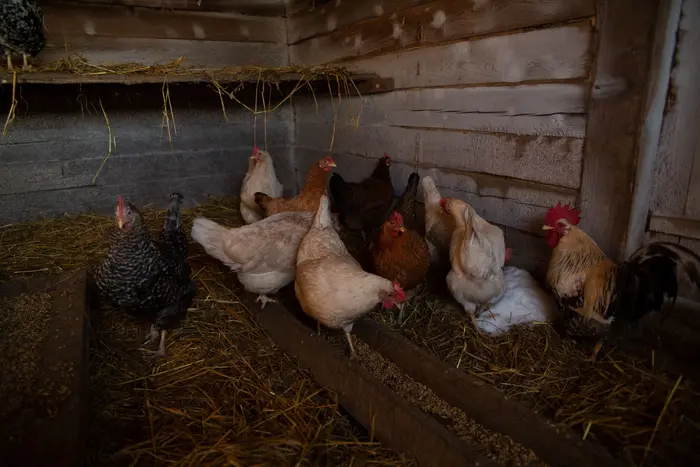
Three things do most of the work in an uninsulated coop, and none of them cost much. The first is flock body heat: a group of 6 or more birds roosting close together generates real, measurable warmth — the more birds, the warmer the coop, which is one reason very small flocks feel the cold more. The second is the deep litter method. Starting with about 6 inches (15 cm) of dry pine shavings and topping it up rather than fully cleaning it out lets manure and bedding compost slowly, and that composting process generates mild heat from the floor up while insulating birds’ feet from cold ground. The third is simply a wind-tight, weatherproof shell — blocking drafts at roost height, while keeping ventilation higher up near the roofline, does more for comfort than any wall insulation.
Between flock size, deep litter and a draft-free build, a lot of coops in genuinely cold climates never need foam board at all.
When insulation is actually worth it
Insulation stops being optional and starts being useful in a few specific situations. The clearest is sustained sub-zero cold: occasional cold nights are one thing, but weeks of daytime highs below 0°F (-18°C) are another, and that’s when a coop’s ability to hold onto any warmth it generates starts to matter. Small flocks are the second case — fewer than about 6 birds means less shared body heat, so the coop shell has to do more of the work itself. Breed matters too: Leghorns and other breeds with tall, single combs are far more prone to frostbite than rose-combed or pea-combed breeds, simply because more blood-rich tissue is exposed to the air. And coop shape plays a role — tall, narrow or poorly sealed coops lose heat faster than a low, tight, well-built one, because they have more surface area relative to floor space.
If none of those apply to you, a well-ventilated, wind-blocked coop with deep litter bedding will almost always outperform an insulated one that’s mismanaged. For more on getting a coop through a hard winter without insulation, see my winter coop checklist.
The insulation mistake that causes more frostbite, not less

Here is the part that trips up almost everyone the first time: insulating a coop without also managing airflow can cause more frostbite than leaving it uninsulated, not less. Chickens release a surprising amount of moisture just by breathing and through their droppings — manure alone is roughly 70% water. In a sealed, insulated coop, that moisture has nowhere to go. It condenses on cold surfaces, soaks the bedding, and raises humidity around roosting birds overnight — and it is that damp air, sitting directly against a comb or a wattle, that actually causes frostbite, not the outside temperature.
The University of Minnesota’s guide on cold-weather chicken care makes the same point: draft-free is not the same as airtight. You want to block moving air at bird height while still letting warm, moist air escape near the roofline — through a ridge vent, gable vents, or gaps left deliberately under the roof overhang. If you ever smell ammonia inside the coop, or see condensation beading on the walls or windows, that’s your sign ventilation needs to increase before you add any more insulation.
What to use to insulate a chicken coop
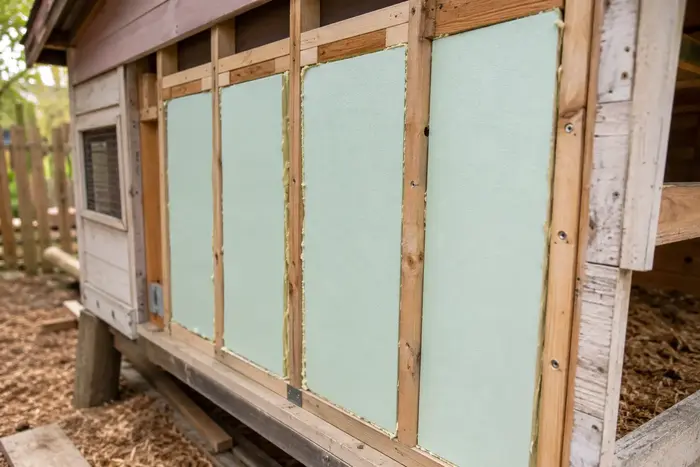
Rigid foam board is the material I’d point most people toward. Polystyrene, polyisocyanurate and polyurethane boards all deliver a good R-value for very little thickness — a 1-inch (2.5 cm) board typically rates around R-6.5 — and they cut to size with a utility knife, which makes retrofitting an existing coop straightforward.
Whatever you choose, it has to be covered. Chickens peck at anything new in their space, and foam board — or, worse, exposed fiberglass batts — will get pecked apart and eaten if left exposed. Cover foam board with plywood, thin paneling or hardware cloth on the inside face, and keep fiberglass out of the coop entirely; the loose fibers and dust are genuinely harmful if inhaled or ingested.
- Rigid foam board (XPS, EPS or polyiso) — best all-round choice; must be covered.
- Reflective foil insulation (e.g. Reflectix) — thin, easy to retrofit into small coops, works best with an air gap on one side.
- Straw bale walls or thick bedding banked against the outside — a low-cost, traditional option for small coops in moderate climates.
- Avoid: exposed fiberglass batts, spray foam without a protective covering, and anything a chicken could peck loose.
How to insulate a coop without cutting off airflow
If you’ve decided insulation makes sense for your climate and flock, the sequence matters as much as the material:
- Measure and cut foam board to fit snugly between wall studs or framing members.
- Secure it with a construction adhesive rated for foam — most standard adhesives will melt polystyrene.
- Seal the seams and edges with foil tape to stop air leaks, but leave existing roof, ridge or gable vents open and unobstructed.
- Cover every inch of exposed foam with plywood, thin paneling or hardware cloth so birds can’t reach it.
- Add or confirm ventilation openings near the roofline — well above roost height — so moist air still has somewhere to go once the walls are sealed up.
- Insulate the roof last if you insulate it at all; a well-ventilated roof cavity matters more in most climates than an insulated one.
A tip on adhesive: use a foam-safe construction adhesive — regular construction adhesive and spray foam can dissolve polystyrene board on contact, so check the label before you buy.
This pairs well with the broader build principles in my ultimate chicken coop guide, which covers sizing and ventilation for a new build from scratch.
Is it worth the cost and effort?
For a small to mid-size coop, expect to spend somewhere in the range of $50 to $200 (€45–€185) on foam board and covering materials, plus an afternoon of work — modest money next to the cost of the coop itself. Whether that’s worth it comes down to the checklist above: sustained sub-zero cold, a small flock, or cold-sensitive breeds tips the answer toward yes. A larger flock in a moderate climate with a solid, draft-free build can usually skip it and put that money toward a heated waterer instead, which does more for winter welfare per dollar than insulation does for most keepers.
Buying a prefab coop instead of building or retrofitting one? Worth knowing: most popular prefab and kit coops — including big names like OverEZ — do not come insulated as standard. You’d still want to add the insulation described above yourself if your climate calls for it.
Frequently asked questions
Do chicken coops need to be insulated in winter?
No, not as a rule. Most breeds handle temperatures down to 0°F (-18°C) in a dry, draft-free, well-ventilated coop with no insulation at all. Insulation is a targeted fix for sustained sub-zero climates, small flocks, or large-combed breeds — not a default requirement.
What is the best insulation for a chicken coop?
Rigid foam board (polystyrene, polyiso or polyurethane), always covered with plywood, paneling or hardware cloth so chickens can’t peck or eat it. Reflective foil insulation is a good lightweight alternative for small coops. Avoid exposed fiberglass batts.
Can a chicken coop be too warm or too well insulated?
Yes. An overly sealed coop traps the moisture chickens release through breathing and droppings, which condenses, dampens bedding and raises humidity around roosting birds — the exact conditions that cause frostbite. Ventilation near the roofline has to stay open no matter how well the walls are insulated.
Does coop insulation help in summer too?
A little, mainly by slowing heat transfer through the walls during the hottest part of the day, but it’s a minor effect next to shade, airflow and access to cool water. Insulation is primarily a winter tool, not a summer-heat strategy.