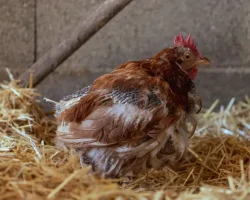
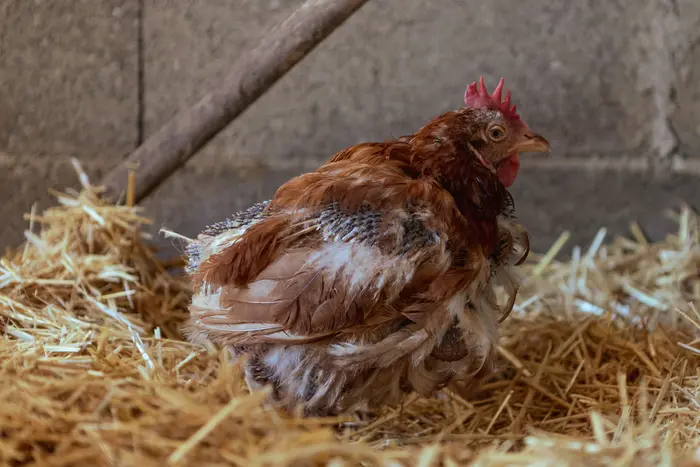
If your once-glossy hen suddenly looks like she lost a fight with a pillow, she is almost certainly molting. Chicken molting is the natural, once-a-year process of shedding old feathers and growing a fresh set — it looks alarming, but it is healthy and expected. In this guide, I will walk you through what molting is, how to recognize it, when it happens and how long it lasts, why the eggs stop, and exactly how to help your flock through it comfortably.
The short answer: Molting is the annual shedding and regrowth of feathers, usually triggered by shorter fall days. Most hens molt once a year after about 16–18 months of age, and it lasts anywhere from 3 to 16 weeks. Egg-laying slows or stops during a molt because your hen’s protein goes into feathers instead of eggs. Here is the part most guides get wrong: once she stops laying, a normal balanced feed already covers her needs. Keep stress low, and if you want to actively support feather regrowth, look for a supplement with the amino acids methionine and cysteine.
The first time one of my hens went into a hard molt, I genuinely thought something was wrong — there were so many feathers in the run it looked like a pillow had exploded, and she stood there half-bald and miserable. A decade of flocks later, I have learned that molting is one of the most misunderstood parts of chicken keeping: it looks like a crisis, but it is really just your hen renewing her coat before winter. Here is everything you need to help her through it.
Key takeaways:
- Molting is the normal, annual shedding and regrowth of feathers — not an illness.
- It is triggered mainly by shortening daylight, so most molts happen in fall.
- A molt usually lasts 3–16 weeks; the first big one comes at about 16–18 months old.
- Hens typically stop laying during a molt and resume once new feathers are in.
- You rarely need a special high-protein feed — a normal balanced diet is enough once laying stops. To support feathers directly, target the amino acids methionine and cysteine, not just crude protein.
What is molting, and why do chickens molt?
Molting is the process by which a chicken sheds its old, worn feathers and grows a brand-new set. Feathers are made almost entirely of protein (keratin), and over a year they get broken, dirty, and worn. Once a year, your hen essentially replaces her whole wardrobe.
The main trigger is daylight. As the days shorten in late summer and fall, the drop in light tells your hen’s body it is time to renew her plumage before the cold arrives — the same shorter days that slow egg production also usher in the annual molt. As Oklahoma State University Extension notes, molting is a natural process chickens go through each year. Growing a full set of feathers takes a lot of protein and energy, which is why a molting hen looks tired, eats more, and often stops laying.
There is nothing to “cure” here. A molt is a sign of a healthy bird doing exactly what nature intends.
How do I tell if my chicken is molting?
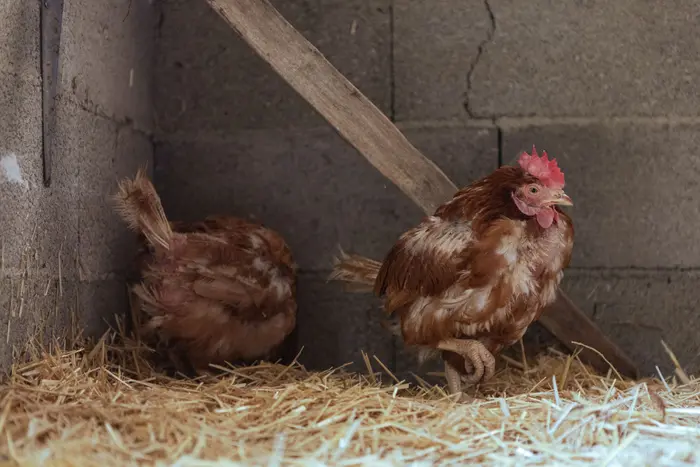
Once you know the signs, a molt is usually easy to spot:
- Feathers everywhere — in the coop, the run, and the nesting boxes.
- Bald or pin-feathered patches, often starting at the head and neck and moving down toward the tail.
- A duller, ragged look and less strutting around.
- A drop in eggs, or laying stopping altogether.
- Slightly withdrawn behavior — new pin feathers are tender, so molting can be uncomfortable.
Molting tends to follow a predictable order: head and neck first, then the back, breast, wings, and finally the tail. New feathers push through as waxy “pin feathers” that unfurl as they grow.
Is it molting or something else?
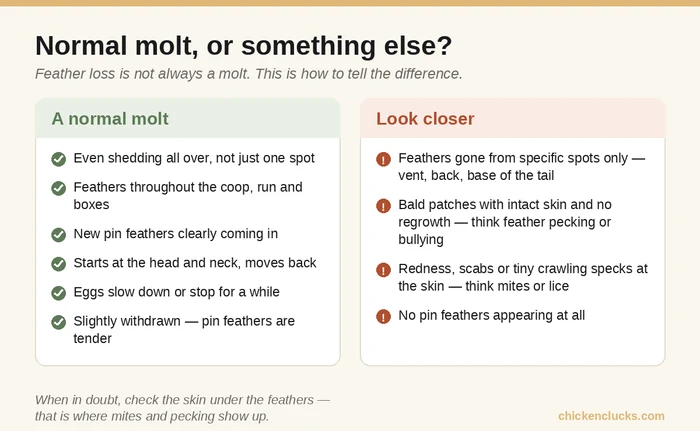
This is the important part, because feather loss is not always a molt. If feathers are missing from specific spots — around the vent, the back, or the base of the tail — and you do not see new pin feathers coming in, look closer. Bald patches with intact skin and no regrowth often point to feather pecking or bullying, while redness, scabs, or tiny crawling specks at the skin suggest mites or lice. A true molt shows even, all-over shedding with new pin feathers on the way. If you suspect pecking instead, my guide on how to stop chickens from pecking each other walks through the causes and fixes.
What months do chickens molt, and how often?
Most chickens molt once a year in late summer or fall — roughly August through November in the US — as daylight decreases. The exact timing shifts a little by climate and breed, but shorter days are the common thread.
Your hen’s first real molt usually arrives at about 16 to 18 months of age. Chicks and young pullets go through smaller “juvenile molts” as they grow, but that first full adult molt is the big one people notice. After that, expect an annual molt each fall.
Molts are not perfectly scheduled, though. Stress — a predator scare, running out of water, a house move, or raising chicks — can trigger an off-season molt in spring or even winter. And yes, roosters molt too, on the same yearly cycle as hens; they just have no egg production to interrupt, so it is less obvious.
How long does a molt last?
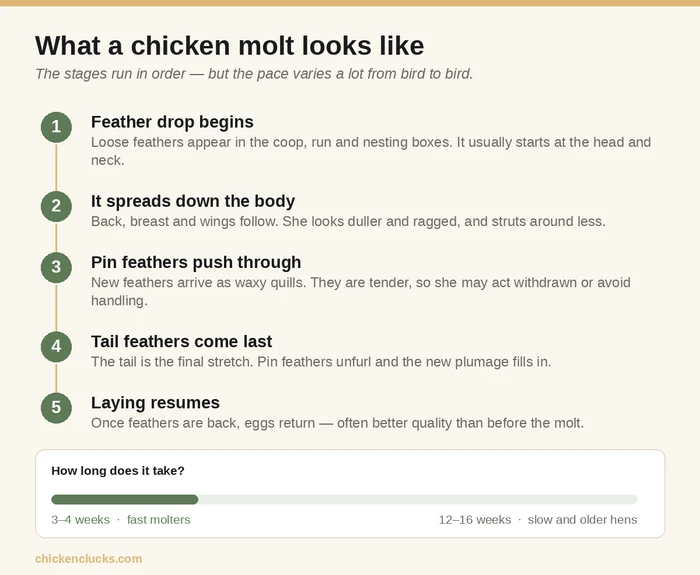
A molt usually lasts somewhere between 3 and 16 weeks, depending on the bird and the type of molt.
- A soft molt is gradual — your hen drops a few feathers at a time and may keep laying. You might barely notice it.
- A hard molt is dramatic — she loses a lot of feathers quickly, can look startlingly bald, and stops laying while she regrows.
Fast molters (often the best layers) tend to get it over with in 3 to 4 weeks. Slower molters can stretch it out to three or four months, and older hens generally molt harder and slower than young ones. A longer molt is not a sick bird — just a slower one.
Will my chickens lay eggs while molting?
Usually not — and that is completely normal. Making feathers takes a huge amount of protein, so your hen’s body prioritizes regrowing her coat over producing eggs. During a hard molt, most hens stop laying entirely; during a soft molt, some keep laying at a reduced rate.
Once her new feathers are in, laying resumes on its own — although if the molt runs into the short, dark days of winter, she may wait until daylight lengthens again in late winter or early spring before returning to full production. If your hens have stopped laying and you are not sure a molt is the reason, my guide on why your chickens are not laying eggs covers the other common causes.
How do you help a molting chicken?
You cannot speed a molt up, but you can make it more comfortable and support strong new feathers. Here is the short version, followed by the nutrition detail that most guides get wrong.
- Keep feeding a normal, balanced layer feed. Once she is laying less, it already covers her needs — no protein boost required.
- Keep stress low. Avoid introducing new birds, moving the coop, or big routine changes mid-molt.
- Handle her gently — or not at all. Pin feathers have a blood supply and are genuinely tender; picking up a molting hen can hurt and can even cause bleeding if one snaps.
- Keep fresh water available. Feather regrowth and a bigger appetite both raise her needs.
Do molting chickens really need more protein?
You will read everywhere that molting hens need a big protein boost — 18–20% feed, a special molt ration. Usually they do not. Producing eggs takes far more protein than growing feathers, so once a hen stops or slows laying to molt, her protein demand actually drops.
A normal, balanced layer or all-flock feed (15–16% protein) already gives a molting hen more than enough — no protein treats or special ration required. Learn more about a balanced feed in my feed and water guide.
If you do look at a special feed or supplement, focus on what feathers are actually built from: the sulfur amino acids methionine and cysteine. Methionine is usually the first-limiting amino acid and the precursor to cysteine, so a little goes a long way; some products add B-vitamins like biotin and riboflavin for skin and feather health. Total crude protein is not the thing to chase.
What about molting in cold weather?
Sometimes a molt runs late and a hen is regrowing feathers just as the cold sets in — not ideal, since she is temporarily short on insulation. You cannot stop it, but you can help her stay warm: keep the coop draft-free but still ventilated, provide deep, dry bedding, and lean into the amino-acid support if you use it so feathers come in fast. Resist the urge to overheat the coop; a healthy, well-fed bird handles a cold-weather molt fine with good shelter. For getting the coop itself winter-ready, see my winter chicken coop tips.
Frequently asked questions
Is it molting or moulting?
Both are correct — it is only a spelling difference. “Molting” is the American spelling and “moulting” is the British, Irish, Australian, and New Zealand spelling; they mean exactly the same process. This guide uses “molting,” so if you searched for “moulting,” you are in the right place.
How do you treat molting chickens?
There is no treatment needed — molting is natural, not a disease. The best “treatment” is supportive care: keep feeding a normal balanced diet, keep stress low, handle birds gently, and provide fresh water. If you want to support feather regrowth specifically, add a methionine-based supplement rather than just more protein. New feathers come in on their own.
Do chickens molt every year?
Yes. After the first adult molt at about 16–18 months, healthy chickens molt once a year, almost always in fall as daylight shortens. Stress can occasionally trigger an extra, off-season molt.
Do roosters molt?
They do — roosters follow the same annual molting cycle as hens. It is just less obvious because they have no egg-laying to interrupt.
Is molting painful for chickens?
Not exactly painful, but new pin feathers are tender and sensitive, which is why molting hens often act withdrawn and dislike being handled. Give them space and they will be more comfortable.
Should I worry if my molting hen stops eating?
A molting hen usually eats more, not less. A bird that stops eating, seems lethargic beyond the usual molt grumpiness, or shows other symptoms may be dealing with something else — watch her closely and separate her if needed.